
BERKSHIRE
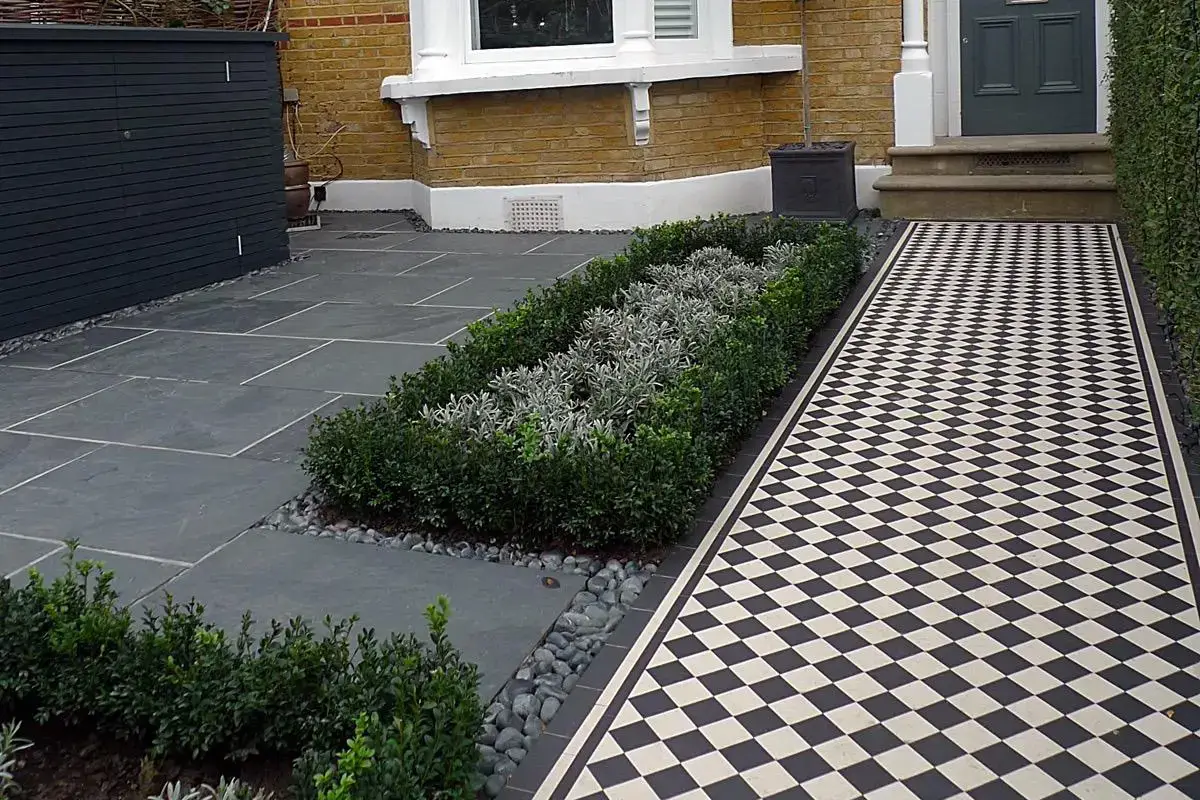
TIMELESS & ENDURING
Natural Stone Paving
Every slab is different. The colour shifts and deepens over time. A well-laid natural stone patio develops a character that manufactured paving simply cannot replicate — and it will still look right in twenty years.
25+
YEARS EXPERIENCE
4
STONE TYPES
100%
ETHICALLY SOURCED
UNIQUE
EVERY SLAB
FREE
QUOTES & SURVEYS
WHY NATURAL STONE
Nothing Else Quite Matches It
Natural stone has been used for paving across Britain for centuries, and there is a reason it has endured. Nothing manufactured comes close. Each slab carries its own tone, its own texture, its own subtle variations — the kind of detail you only really notice once it is laid, and the light catches it differently through the day.
Over the months and years that follow, the colour deepens. A patina forms that no factory can reproduce. Where concrete fades and composite materials date, natural stone simply gets better. It belongs to the property it sits alongside, not to a catalogue.
But it is not a forgiving material to work with. Thickness varies. Absorption rates differ between stone types. Pointing, sealing, cleaning — all need to be handled according to the specific stone. Get it wrong, and you end up with lippy slabs, efflorescence, acid damage, or a patio that looks nothing like the sample you fell in love with.


OUR STONE RANGE
Four Stones, Each With Its Own Character
We work with sandstone, limestone, granite and slate. Each behaves differently — and understanding those differences is what separates a patio that lasts from one that does not.

Indian Sandstone
The most popular natural stone for UK patios. Warm tones — buff, brown, pink, grey — with a riven texture that gives each slab genuine character. Porous, so we recommend sealing after installation.

Limestone
Smoother and more refined than sandstone, with cool grey and blue-grey tones. Perfect for modern garden designs. Dark limestone is striking but shows efflorescence early on — we will walk you through this.

Granite
The hardest stone available — virtually non-porous, frost-proof, and extraordinarily long-lasting. Higher cost, often used for steps, edging and accent features. Silver-grey sawn granite is our most requested finish.

Slate
Rich charcoal and blue-black tones with a distinctive natural cleft. Dense, frost-resistant, and naturally resistant to algae. Its riven surface needs careful laying, but the result is genuinely beautiful.
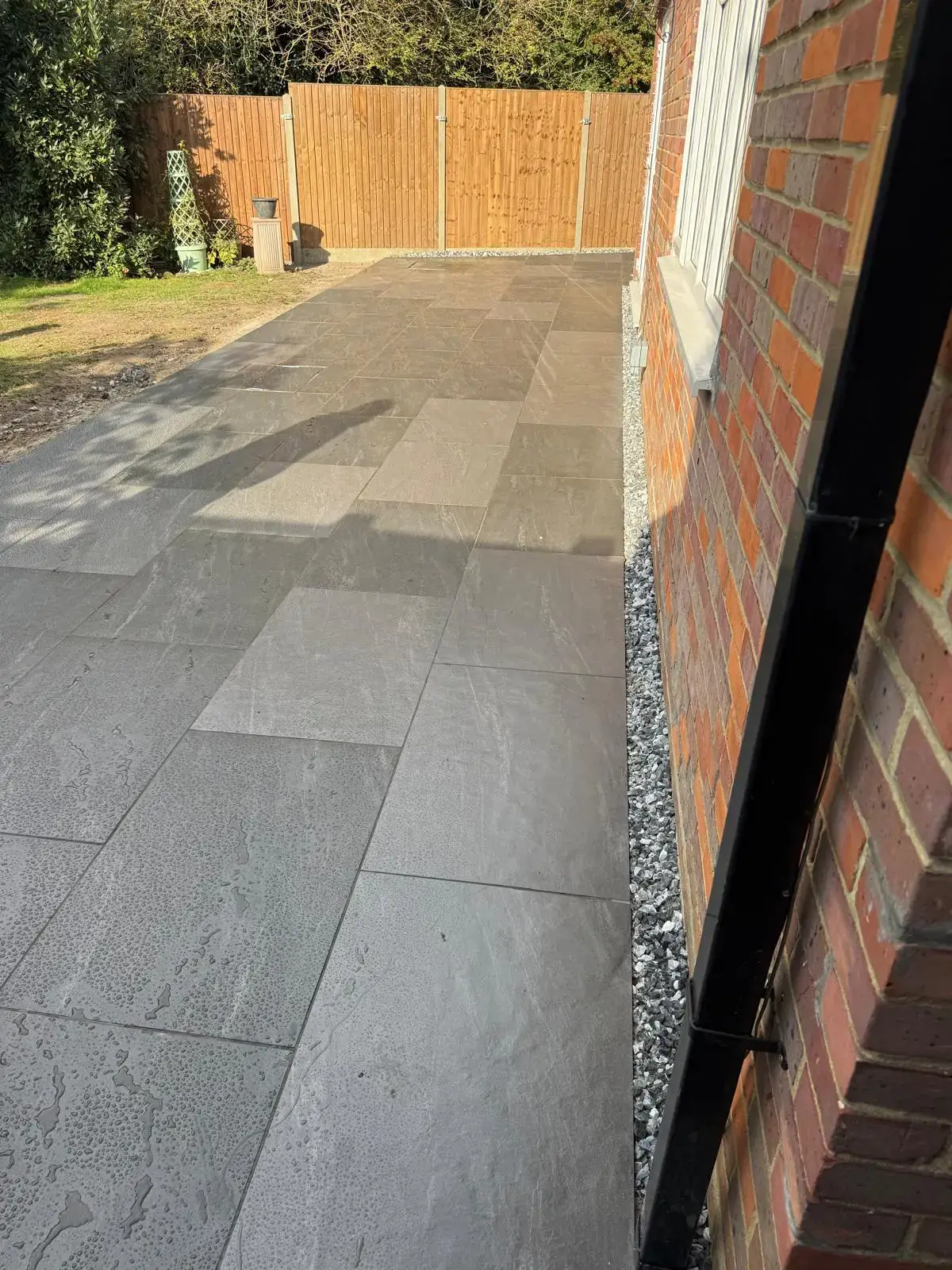
CUSTOMER STORY
“It Looks Better Every Year”
“We wanted Indian sandstone but were genuinely worried about staining and how much work it would need. Urban Stone sealed the patio after laying it and talked us through the aftercare properly. Three years on, the stone has developed this lovely patina and we haven’t had a single stain. Honestly, it looks better with each passing season.”
— Helen and Tom R., Hertfordshire
SURFACE FINISHES
How the Surface Is Finished Changes Everything
Riven
Hand-split along natural layers. Textured, uneven surface with traditional character. Ideal for cottage and period settings.
Sawn
Machine-cut on all six sides. Smooth surface, precise edges, contemporary look. Calibrated thickness makes it quicker to lay.
Honed
Polished to a matte sheen. Elegant, understated look — particularly popular for limestone patios and indoor-outdoor flow.
Tumbled
Mechanically aged for a weathered, reclaimed appearance. Softened edges and a natural patina from day one.
Sandblasted
High-pressure sand treatment creates a dimpled, non-slip surface with softened colour tones. Good grip in wet conditions.
HOW WE INSTALL
The Detail That Makes the Difference
Natural stone demands precision at every stage. Here is how we approach it — from the ground up.
01
Sub-Base Preparation
We excavate to depth for a minimum 100mm of compacted MOT Type 1, plus mortar bed and slab thickness. On clay soils we lay geotextile membrane first. Everything is compacted in layers and graded for drainage.
02
Full Mortar Bed
Always a full mortar bed — never dot-and-dab. Sharp sand and cement at 5:1 or 6:1 ratio, adjusted beneath each slab to achieve a level surface. This is where the skill lies, particularly with riven stone.
03
Colour Mixing
We open every crate at the start and draw slabs from each one throughout the laying process. This prevents colour banding — those obvious patches where different crates were opened one at a time.
04
Jointing
Sand-and-cement pointing, polymeric compounds, slurry-applied resin grouts or two-part epoxy — we match the jointing system to the stone type, the joint width, and the base construction beneath.
05
Sealing
Breathable impregnating sealant that penetrates the surface rather than forming a film. Stone must be completely dry, with at least 24 hours of dry weather forecast. We never seal over efflorescence.
06
Final Inspection
Spirit level checks across every joint. Aftercare guidance for your specific stone type. We provide a detailed materials summary so you know exactly what was used and how to maintain it.

MEET MATT
The Person Behind the Patio
I have been working with natural stone since I was seventeen, when I started as a labourer for a small landscaping firm in Berkshire. That was more than fifteen years ago, and honestly, stone still surprises me. Every batch is different. Every site has its own quirks — the drainage, the soil, the way the light falls on a south-facing garden wall.
What I have learned over the years is that natural stone rewards patience. You cannot rush it. The mortar bed has to be right. The colour mixing has to be considered. Even the weather on the day matters when it comes to sealing. Most of the problems I see on other people’s work come down to shortcuts — dot-and-dab instead of a full bed, no colour mixing from the crates, or using the wrong sealant for the stone type.
I set up Urban Stone Developments because I wanted to do this properly. We are a small, family-run team, and that is deliberate. I know every project we take on, and I am on site for the work that matters. If something needs sorting, you speak to me directly — not a call centre.
We are not the cheapest. But when you are investing in stone that will outlast the mortgage, you probably want it laid by someone who actually understands it.
Matt, Founder
IMPORTANT WARNING
What Not to Do With Natural Stone
This might be the single most important paragraph on this page.
The most common cause of irreversible damage to natural stone patios is cleaning with brick acid — hydrochloric acid. Contractors use it routinely to clean mortar residue from concrete paving, but on natural stone it is devastating. It reacts with the minerals in the stone, etching the surface, bleaching the colour, and causing permanent damage. There is no fix. You cannot undo it.
We never use acid-based cleaners on natural stone. Full stop. If mortar residue needs removing after installation, we use pH-neutral stone cleaners that are formulated for the specific stone type. It costs more and takes longer. But the alternative is a ruined patio — and we have seen far too many of those.
Never Use Brick Acid
Causes permanent etching, bleaching and mineral damage to all natural stone
No Dot-and-Dab
A full mortar bed is essential — dot-and-dab creates voids, uneven settling and cracked slabs
Do Not Seal When Wet
Stone must be completely dry with 24 hours of dry weather forecast before sealing
Do Not Skip Colour Mixing
Laying one crate at a time creates visible colour banding across the finished surface
WHY URBAN STONE
Family-Run Quality Since 2008
We are a small team by choice. It means I know every project, every site, every client by name. There are no subcontractors arriving on your doorstep unannounced. The people who survey your garden are the same people who lay the stone.
We understand the specific requirements of sandstone, limestone, granite and slate — from the mortar bed to the sealant. And we take the time to explain each stage to you, so there are no surprises. Our quotations cover everything: excavation, disposal, sub-base, stone supply, installation, jointing, sealing and drainage. No hidden extras.
Family-Run Business
Stone Specialists
Ethically Sourced Stone
Clear Guarantees
No Hidden Costs
Premium Materials Only
SERVICE AREAS
Natural Stone Paving Across the South East
We install natural stone paving across London, Berkshire, Essex, Kent, Surrey and Hertfordshire. Whether you are in a townhouse in Richmond or a detached property in the Hertfordshire countryside, we will visit, discuss stone options with physical samples, and provide a detailed written quotation covering every element of the work.
London
Berkshire
Essex
Kent
Surrey
Hertfordshire
FAQ
Frequently Asked Questions
Which natural stone is best for patios in the UK?
Indian sandstone is the most popular choice because of its warmth, range of colours, and value for money. Limestone suits modern, contemporary gardens with its smoother finish and cool grey tones. Granite is the most hard-wearing but comes at a higher price point. We will bring samples to your site visit so you can see the options alongside your property.
What is the difference between riven and sawn stone?
Riven stone is hand-split along its natural layers, giving it a textured, uneven surface with a traditional feel. Sawn stone is machine-cut for a smooth, precise finish that suits contemporary spaces. Riven stone varies more in thickness and needs more skill during laying; sawn stone is calibrated and generally quicker to install.
Does natural stone need sealing?
We recommend sealing most natural stone after installation, particularly sandstone and limestone. We use breathable impregnating sealants that protect against staining and moisture while allowing the stone to release moisture naturally. Granite rarely needs sealing. We will advise on the best approach for your specific stone choice.
What is efflorescence and should I be worried about it?
Efflorescence is the white mineral deposit that appears as moisture evaporates through porous building materials. It is a natural process and resolves on its own as rain washes the salts away. On dark limestone it can be particularly visible during the first few months. We explain this before installation so you know what to expect and are not caught off guard.
How long does a natural stone patio installation take?
It depends on size, complexity and the stone type. A straightforward patio might take three to five days; larger or more complex projects — with steps, retaining walls, or drainage work — can take longer. We provide a detailed timeline during the quotation stage so you know exactly what to expect.
Is your Indian sandstone ethically sourced?
Yes. The Indian sandstone we supply comes from accredited quarries with documentation confirming compliance with fair labour standards. We take sourcing seriously and can provide full provenance details for the stone used in your project.
Can I use a pressure washer on natural stone?
You can, but with caution. A low-pressure setting (below 120 bar) with a fan nozzle is generally safe for sandstone and limestone. High pressure or a pinpoint nozzle can damage the surface and blow out jointing compound. Never use a pressure washer on unsealed stone without advice — and never use brick acid. We provide full aftercare guidance with every installation.
Request A Free Quote
“The limestone patio is exactly what we wanted — clean, modern, and perfectly flat. The team explained the efflorescence that would appear initially and how it would clear, which meant we were not caught off guard. Really professional from start to finish.”
Andrew S.
Surrey
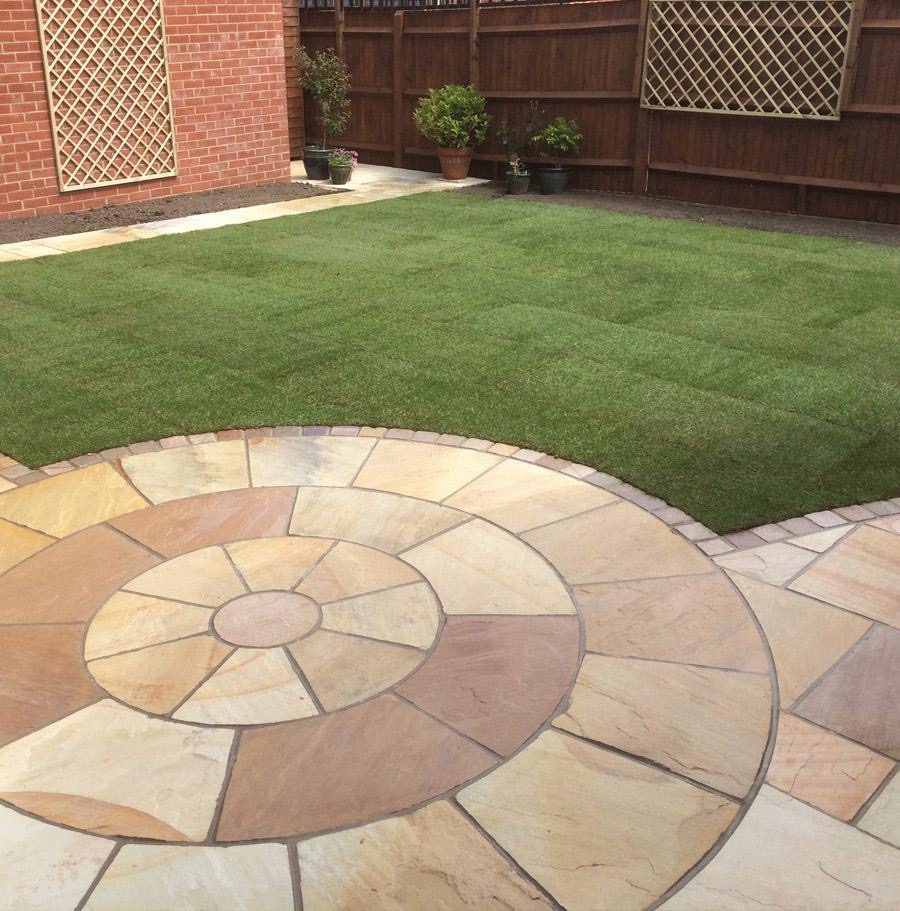
Beautiful Natural Stone, Expertly Laid
Sandstone, limestone, granite and slate — installed by specialists who understand each stone’s unique character. Serving homeowners across London, Berkshire, Essex, Kent, Surrey and Hertfordshire since 2008.